
The Society for Canadian Philately
- BNAPS Online Resources
To order this book from BNAPS books Sales Agent Bill Longley, click on the book's price at right.
BNAPS books are available from:
Bill Longley
c/o Longley Auctions
PO Box 620
Waterdown, ON L0R 2H0
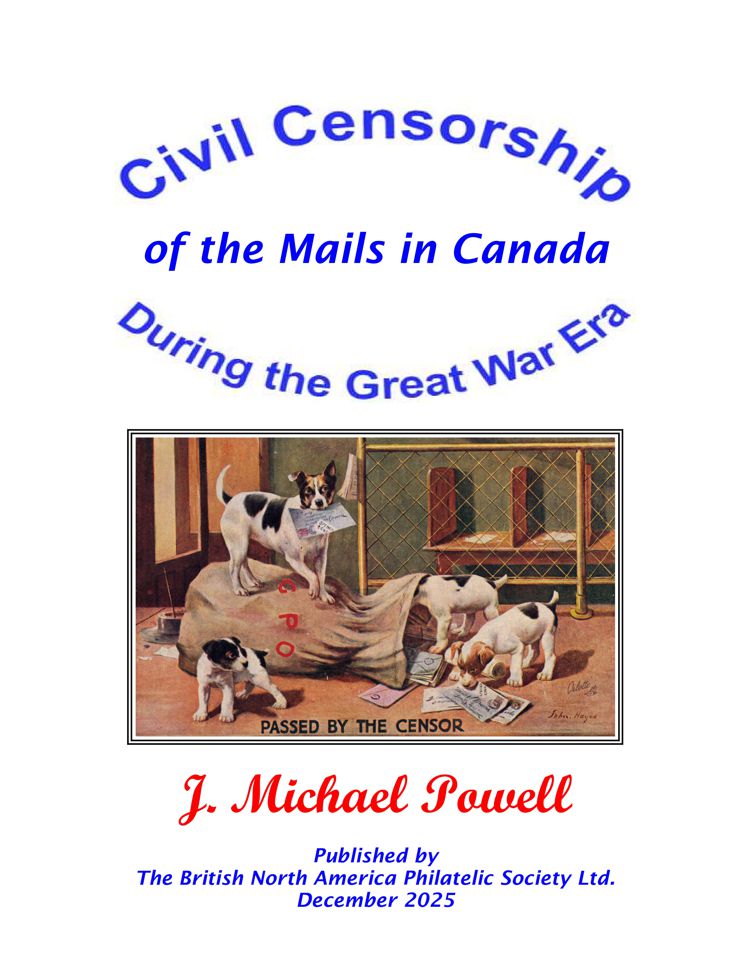
Civil Censorship of the Mails in Canada During the Great War Era
J Michael Powell
Released December 2025.
558 pages, 8.5" x 11", spiral.
Colour C$
99.00 [ISBN 978-1-989280-54-6].
In his fourth BNAPS book, author Mike Powell shifts from looking at mail to and from Canadian and other Prisoners of War in both 20th century world conflicts. In this book, he focuses on how mail between Canada and myriad countries, friendly and unfriendly, was kept as safe as possible before and during World War I.
The First World War began in the summer of 1914 and spread slowly across the entire world. As Canada gained its war footing, censorship was first placed in the hands of censors based in Ottawa. Initial efforts are perhaps best described as sporadic and surviving early examples are rare. The Dominion Police were also engaged to assist the military in Prisoner of War Mail censorship until they could establish their own system. Nationwide sampling of certain mails was conducted in April of 1916 and again in April of 1917. Temporary censor stations were established mainly at border cities and towns. One significant research element in Mike’s work is the establishment of a tentative list of the towns engaged in the 1916 effort. The 1917 stations are known from government sources.
In addition to Ottawa, permanent censor stations were established in Vancouver and Halifax. Over time, numerous censorship protocols were established at these stations, and this work discusses them all.
Vancouver looked after the entire Pacific, including mail to and from China, Japan and eastern Russia. A primary source of the mail to be checked resulted from the normal sailings of ships of the Canadian Pacific Line, including a contract to examine mail from the United States Postal Station at Shanghai, China, before the United States entered the war.
The Halifax station was established by the British military to examine mail carried aboard neutral country ships passing through that port.
The central Ottawa station looked after mail to and from neutral European countries such as Holland, Switzerland, Ireland and the three countries of Scandinavia, as well as the almost entirely neutral countries of Mexico and Central and South America. That station was also involved in the censorship of certain Prisoner of War mail. Several other special censorship protocols were established there.
This book examines in detail the censorship elements (labels and handstamps) used at all the stations, both temporary and permanent.
An item of interest to students of the subject is an Appendix of a near 100 page report prepared by the Government in 1920 summarizing the WWI censorship activity. It contains useful information beyond just the civil censorship activity.
Copyright © 2015 - 2026 The British North America Philatelic Society.
The documents on this website are for informational and non-commercial or personal use only.
Documents on this website shall not be used on other websites or for
commercial purposes without permission.
This page was last modified on 2025-02-24.